Monday, 8 June 2015

2014 2 Meters FISTS CW Award

Delighted to receive a certificate for 1st place in the 2104 FISTS CW Club 2 meters activity event. 

It was particilarly satisfying as the VHF activity was a FISTS tribute to Angie G0HGA and I did meet her many years ago when we both sat our CW test together. I was then G1UUM and living in High Wycombe, a particularly poor VHF location at the bottom of a deep valley. That was the original inspiration for learning CW in order to get the treasured "A" licence and to be able to work on HF.  While I was struggling to reach the necessary 12 wpm, she was, even back then, rattling it out like a seasoned pro. She did make quite an impression on me then and I was saddened to hear that she went SK.

Many thanks for all the QSO's that made this award possible.

73 


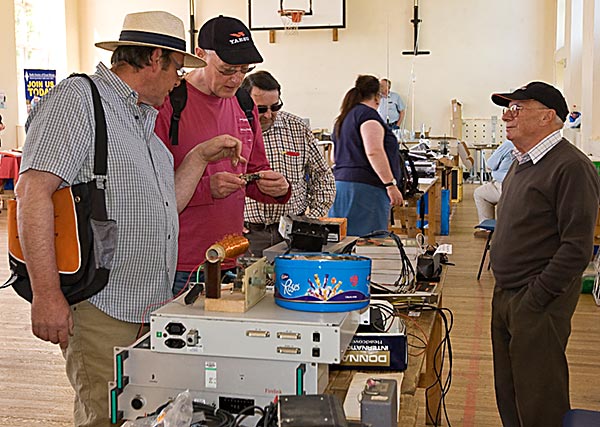
SDARS 2015 Rally


Monday, 11 August 2014

FSK and Meteor Scatter on 2 meters

My local Raadio Club, Spalding and District Amateur Radio Society (SDARS), recently had a video presentation, talk and demonstration on the use of FSK with WSJT  Software for making long distance contacts on 2 meters using Meteor Scatter.


This was a very timely talk as the Perseid Meteor Shower was due in a few days along with a DXpedition to IO41 by EI9E.

I must say that I had used this mode before, or I should say I had WSJT working before, but I had never made any contacts with it. I simply did not really understand what Meteor Scatter was all about. I certainly did not realise that this was a mode that can be used at any time as Meteors are constantly entering the Earth's atmosphere.

The video was by GW8JLY which told us what FSK and Meteor Scatter was all about. It was a very comprehensive video that didn't get bogged down in too many technicalities. Further explanation was given by Bob, G1ZJP, and then a practical demonstration was given by Julian, G4YHF, in the Club Raadio Shack which put the theory into practice. 

Still fired up with enthusiasm, I couldn't wait to give this a try at home and the next day was on 144.370 listening out for signals. I saw some decodes on the screen from OH6KTL and decided to give him a call. After a few QRZ's he got my call and after some time sending info to and fro, we completed the QSO.

So I had made my first Meteor Scatter QSO using FSK and WSJT software. OH6KTL is in KP02OJ, a distance of 1649 Kms and just using 30 watts to an 11 ele Tonna at my end.
I think that this is a mode that I could get into and will definitely be trying it again.

Thanks to SDARS for being such a pro-active Club. This is not something that I would have achieved before the presentation. Thanks guys.

73 De Jim GØHGH

.

Sunday, 3 August 2014

Deaf????

At some point every Amateur Radio operator must get filled with self doubt and wonder whether or not his signal is getting anywhere. Likewise, when listening to a fairly deserted band, is it imagination or is there actually a signal in that noise that I can just not make out. It must be sign of my insecurity in that, when I get some adverse criticism, I always think that it is me to blame.

In July, FISTS started a two meter activity event for an hour on Saturday evenings and another hour on Sunday mornings. In that first month I received more listener reports than I had QSOs. On the Yahoo group conversations it became evident that many operators were using low power and a  vertical antenna: the cross polarization losses are quite large so I was not too concerned.

In August, a suggestion was made that I was running huge power and  was extremely deaf! Perhaps someone should talk to me about it? Comments like this only fuel my anxiety so was starting to become a little concerned. I usually run 75 watts to an 11 element beam up about 10 to 15 meters agl depending upon wx conditions (and whether or not I got up early enough to pump up the mast).

Fortunately I have been competing in the RSGB UKAC Contests for a few years now and, if nothing else, they have given me a very good idea how well or poorly my signals have been radiating around Europe. For instance, when I first started contesting it was with a vertical antenna and 8 watts. Not surprisingly, my signal did not get very far, a maximum of 100Km, so it wasn't long before I upgraded to a 6 element 2 meter beam. That made a huge difference and I was working stations up to 250 Km away without too much trouble. Next came an upgrade to my current set up; an 11 element beam and 100 watts. With this station I find that I do fairly well and am confident in having a good idea on what I can expect from it. attaining 450 Kms is not unreasonable.

CW is a mode much more suited to making longer distance contacts so I was quite keen when the FISTS 2 meter activity sessions were announced. When I look at the log and analyse the QSOs they are however a bit disappointing. I have had two, quite hard work, contacts at 300 and 220 Kms where I gave 429 reports and received 579. Most other contacts have been quite local.

Interestingly, during one session I was called by a Contest station in IO75 and we exchanged very good signal reports (not unsurprising for contests!) but the QSO was pretty much as I expected - easy copy both ways and that was at 479 Kms.

So am I deaf or do FISTS members just not put out big signals? As I mentioned earlier many are using verticals, assuming a cross polarization loss of 25 Db and my antenna has a gain of 12 DB (assuming I have them perfectly aligned) that still leaves a loss of 13 Db. If the other station is running 5 watts from an FT817 or similar, that 13 Db loss is extremely significant. Not surprising then that if I am not perfectly aligned they are simply not audible here.

G0ILN has installed an HB9CV antenna at his stataion in JO00 square and he runs just 5 watts. I gave him a 429 report and I received 579 in return at a distance of 217 Kms. Another station in IO83 has a dipole sellotaped to his wardrobe door and can hear me, but I cannot hear his 5 watts. I really do not find that very surprising. Or am I too easily satisfied?

73 es good dx de Jim GØHGH 


Wednesday, 30 July 2014

70 MHz UKAC

I have never made any bones about it, I am just not really a /P operator. My last venture onto 4 meters was from a good, high location in Somerset and I did abysmally. Four meters is not a band that I had any equipment for so all of it was borrowed. Unfamiliarity tends to add the general state of confusion that I find myself in while portable operating. Fortunately there are not many 5th Tuesdays in the month to worry about so I have lived with the situation.

For this months 4 meter UKAC I was at home and determined to do a bit better. I ordered a 4 element beam from Andy, our "antenna man" at SDARS and also spent a bit more time setting the station up. The Transmitter was the same borrowed kit, An FT690 with transverter and small linear giving 20 watts. As usual I checked out the band plan to make sure where I knew where I was supposed to be going. 70 MHz is a bit different from other bands in that the bottom segment is for beacons and not CW. Phone and key share a calling frequency of 70.200 MHz.

The biggest improvement to my station was the addition of my shack headphones. I had taken them along last time but had the wrong 1/4" to 3.5mm adapter and could only hear from one earpiece!

Conditions were quite flat for the contest and that is fine by me as when others score very well, I tend to just score a little better than usual. A flat band tends to even out the "luck" of sporadic E contacts.

I passed my last efforts within the first hour so was well pleased. I went on to make 42 contacts in 12 multiplier squares.

I was happy to work several squares that often evade me, IO90, IO94 and IO95 but still cannot manage to find the number of squares more experienced contesters can conjure up.

Overall it was an enjoyable contest with a mixture of search and pounce along with some sessions calling CQ.

Many thanks to all for the points and hope to work you again in the next UKAC.

73 de Jim GØHGH


Tuesday, 17 June 2014

June 17th 23 Cms UKAC

23 Cms is a fairly new band for me and it is one that takes some getting used to. Not only do you operate the radio but you also have to arrange skeds using KST. It certainly adds another dimension to Contest operation.
Being fairly new to the band it should be quite easy to better your last score and so far things have been going in the right direction. This was certainly a personal best result for me. It wasn't down to the number of QSO's but to the number of multiplier squares worked - a total of 15 which I was very pleased with.

There was a lot of deep QSB on most distant signals with total fade out at some points so some perseverance was required on both ends of the contact.

I was pleased to say that CW played a small part n pulling in some of the weaker signals. Certainly G3YPQ/p in IO70SS would never have been worked on phone. I gave him a 529 and I received a 449 so it just goes to show how useful CW is in difficult conditions.

I run 10 Watts to a 55 ele Tonna up at 12 meters agl so low power but with high gain. A very sharp antenna so constant tweaking of beam heading made more difficult by QSB made it all quite hard work but most enjoyable.

There were a few SDARS stations on including G4YHF, G4ODA, G4NBR and G4KIY. Strangely I did not hear G4ODA all evening despite the fact that we are fairly close to each other.

73 es tnx fer all points.

Wednesday, 11 June 2014

80 meter UKCC Contest

CW contests are a bit of a strange affair really. I am normally found, plodding away at about 17 wpm on my paddle but as soon as you mention "Contest" we all become speed freaks. Unfortunately, I am just not very accurate sending or receiving above 20 wpm so some practice is prescribed.

The RSGB UKCC Contests on 80 meters are quite a relaxed affair really, and even has a designated frequency of 3.555 MHz for slower operators to have a go. Sadly a couple of DL's decided to have a very high power QSO on that frequency for a good part of the June Contest but as the band was not that crowded, it didn't detract very much from everyone's enjoyment. I usually concentrate my efforts towards the top of the band segment as things get more frantic the lower in frequency that you go. In fact the bottom 30 Hz tend to be rather manic.

In April I managed 38 contacts and in June's Contest manged to improve slightly making 43 contacts. Still a long way to go but I do not take it very competitively. For me it is about gaining experience and self improvement.

As mentioned, Contest operation is usually at much higher speeds than normal rag chewing and you really need to get your ears tuned in for a specific exchange. As all HF CW contest signal reports are 599 all you really need is the 3 digit number that follows the RST and the Call sign of course. This part of the exchange is typically sent at between 25 and 30 wpm, much too fast for most of us mortal operators, but it is amazing how fast you can read that limited exchange when you know what to listen for and practice for it.

Fortunately numbers are longer than any other Morse Code character so that helps. Unfortunately, many experienced ops tend to use abbreviated forms for the Zero and number 9. Whilst I don't mind the leading zeros being shortened to a "T" in the exchange (TT1), nor do I mind the 599 being sent as 5NN, but when they appear in any other place it disturbs my rhythm and makes me stop and think - a practice fatal in decoding CW. 

Search and Pounce (S&P) mode is the easiest mode to use as you have plenty of time to catch the call sign of the station that you want to work. Even if they are sending at 25 wpm you can normally get it correct if you listen to it a few times. Once you have his call sign in your logging programme all you have to do is send your own call sign once and then listen to hear if he is calling you back or someone else. Assuming the other station heard you correctly all you need to do is enter the default 599 for the RST and then listen for the next 3 numbers - your serial number. Even if you miss it and are too embarrassed to admit it you can listen for the number given to the next few contacts that station makes and work backwards to the number that you were given. Not too bad really. Then you just send 5NN and your 3 figure serial number to him. Simple really isn't it?

Whilst S&P is the easiest way to make contacts, you really need to call CQ to make the points. Then accurate copying of the other stations call sign is vital and it is not always easy when the band is crowded and you have QRM to contend with. You can practice call sign recognition though with contest emulator programmes like Morse Runner. Calling CQ and establishing a run frequency is much more stressful so start with S&P mode if you want.

Contest operating on the HF bands is not everybody's cup of tea but it is a great way to improve your own operating technique, gain confidence using CW and also to learn how to utilize some of the many controls on a modern rig, especially in the filtering department. 

To begin don't take things too seriously and just enjoy it. Get out of it whatever it is that you want and leave winning to the big boys. They are great for call sign recognition which is one of the most important skills that you can develop for using the HF bands outside of those dreaded contests.

If you feel like giving CW contests a go but are not confident enough, then contact me at the Club (SDARS members) and we can organize some practice sessions on the computer and/or on the key.

73 es gud dx de Jim G0HGH