Tuesday, 31 March 2020

Amateur Radio in testing times.

The new buzzphrase is "Social Distancing" and you would have thought that most Radio Amateurs were well acquainted with solo operating but there is also a very sociable side to our activities. Our local Club in Spalding meets (or used to) every week, hosts one of the biggest annual Rallies in the Country as well as several smaller public events throughout the year. In the new medical environment of a virus infected World, all of those public activities have sadly been curtailed for the time being.

The Club is still very active though. We now have an active net on 2 meters instead of a face to face meeting. Some of our younger members have been actively supporting the more vulnerable with physical help with shopping and other chores.

In these strange and testing  times Amateur Radio has become an even more important life line than ever before. Crisis bring out the best of everyone and that is certainly true of our Club members. Let us hope that this emergency will soon run its course and we can get back to some sense of normality but, in the mean time, a huge thank you to all of those contributing to keeping spirits high.

Best 73 es 88


Sunday, 31 March 2019

CW Contests or knitting?

When operating in CW Contests I am normally one of those operators who Search & Pounce (S&P) across the band, never having the confidence to try calling CQ and hold a Run Frequency. In addition to lack of confidence, I have never had a lot of success calling CQ, which I had always attributed to running modest power levels on a crowded band. 


During a recent UKEI CW Contest, I ran out of new stations to call and thought that I would try calling CQ for the last 10 minutes to see how it would go. I was amazed to hear at least 4 stations calling me at the same time and spot on my frequency - my ears and brain went into melt down and I experienced blind panic for the first time in many a year. I have never been on the receiving end of a pile-up before and it was a very sobering experience. CW Contesting has always been a specialised business that attracts the elite of operators but I came to the conclusion that CW Contests are getting more challenging every year. I think that I have identified a couple of reasons for this;


  • Operating seems to me, to be getting faster these days. I am not sure if the standard of operating is getting better or whether the use of decoders such as FlDigi or CwGet make copying fast CW easier. Certainly, the use of logging/operating software like N1MM makes sending very fast, accurate CW easier than ever before.
  • With waterfall displays and Contest overcrowding becoming so prevalent, stations returning a CQ call are virtually spot on frequency. Whilst on the face of it, this should make operating easier, in fact, trying to single out a particular caller in a pile up with exactly the same tone is, to my ears, impossible.

I did persevere and managed to add a few more calls to my tally but it was a very harrowing experience and, to be honest, a little embarrassing. I vowed to improve my technique or take up knitting. Fortunately there are several pieces of software available to help. One that has survived the test of time is "Morse Runner", a programme that very realistically recreates the contesting experience. It is probably a bit early to evaluate any self improvement but my copying speed and accuracy is definitely improving but I still find pile-ups extremely challenging. Even without the stress of live operating the feeling of absolute panic sets in and the brain fades into static as all calls melt into one meaningless tone. I recently mentioned this to other Spalding Club members and was reminded what it must be like for rare DX stations , like the Bouvet Island expedition, operators. OK, but at least they have the luxury of being able to operate split frequency that Contesting does not afford. 


I will carry on with Morse Runner for a bit longer but even so, more kudos to those DX and Contest operators who run pile-ups so efficiently. They make it sound so easy. Now, in my very modest fashion, I can appreciate just how good you need to be to carry it off.


With any luck my next attempt to call CQ during a CW Contest will be a little less embarrassing than the last time but many thanks to all whose patience is tested in the process. Maybe, just maybe, I'll never call CQ again and take up knitting instead.


Tuesday, 5 March 2019

Ageing ears

The years roll mercilessly past and as much as I would like to deny their passing has any relevance in my life, I have finally had to admit that they have taken a toll on my hearing.

For many years now the default frequency that I have set my CW sidetone to has been 750Hz. This has always been the optimum frequency that my "brain filters" manage to distinguish the required CW signal from the pileup. It has also been the frequency that I have found most comfortable to listen to, especially during Radio Contests, when I can be listening intensely for several hours at a stretch.

Last week I was operating CW in the RSGB 80 meter Club Championship Contest, a contest that I usually find quite relaxing. However after about an hour of operating I noticed a distinct  feeling of ear/brain fatigue. I was finding it increasingly difficult to separate the required signal from the crowd.

Returning to normal operating several days later, I was listening to a pileup on the radio and found some signals distinctly easier to read than others. I booted up FlDigi so that I could utilise the waterfall to anylise what I was listening to. It was an interesting exercise as I found signals on my usual 750Hz were definitely "down in the noise" compared to some others. When I adjusted the same signal up in frequency it magically popped out from the crowd. I tried tuning the signal to various frequencies before settling at 950Hz. At this frequency my ears could tune in much more clearly, any higher and it became irritating to listen to.

After several days of using 950Hz as my default sidetone I can definitely say that CW has become much more pleasurable again. I can also see why, when calling a rare station in a pileup, it could be advantageous to call him slightly higher in frequency, rather than on or below it.

Perhaps time to book a hearing test!


Sunday, 20 January 2019

Nostalgic Night

Technology marches on in all forms of modern life but, it seems, non faster than in the field of Amateur Radio. It is a long time since I have had to tune my radio receive and transmit for sensitivity and power, manually tune an antenna or manually paper log. 

I am not knocking modern equipment and practices, far from it, I actually embrace  and love them, but, it can induce a feeling of complacency as I take all of this modern convenience for granted. Worst of all, it makes me lazy and I need very little encouragement to pursue that route.

Operating "Digi" modes for me once meant using a computer for RTTY but those times are long gone. There are so many different digi modes now that I am at a loss to know what many of them are, or recognise them when I hear/see them. 

At my local radio club, S&DARS in Spalding, it is plain to see the attraction of these new modes especially amongst younger members. Indeed, it is a healthy sign that Club membership is increasing and most noticeably, is also attracting a younger generation into the hobby, many of whom are very active on the digital modes.

I try to keep up to date and am moderately active digitally but I often yearn for for the simple life, especially after a computer system or interface problem. For me back to basics usually means a barefoot radio and CW into a simple dipole antenna. This is my safety blanket when I feel threatened by temperamental technology.

Recently I came across notification of a contest using the Feld Hell mode and, when I saw that it was based on 1920's facsimile technology, I was tempted to give it a listen. Little did I realise that this was to breathe a fresh wave of enthusiasm into radio that I had not experienced in many a year. It was so refreshing to actually tune the bands looking for signals, adjusting the radio for best reception and then manually typing in responses to calls in the log because I had not got any macros pre-prepared. 

Not being familiar with Feld Hell at all the first problem was finding a signal. On the Feld Hell Club web site they give recommendations but they are fairly broad. Fortunately, another S&DARS Club member, Andrzej M6OIZ, was tuning around and I heard/saw his signal on my screen. Neither of us had worked Hell before so did not really know what we were doing or what to expect. Not to be intimidated by ignorance we plunged in and helped each other out, completing a QSO. Feld Hell is a really relaxed mode to operate. It is; 

  • fairly slow so is easy for us, one fingered, typists. 
  • It sounds similar to slow morse so nice to listen to, and
  • It is strangely hypnotic watching the call scroll slowly across your screen.
I then went off and searched the bands for more signals but only found others on 80 meters. As it got close to midnight, when the contest ended, other stations must have got more desperate for contacts and I managed to work SQ3LMR, SA7CND and EC1RCB with several others heard but not worked.

There are a number of software programmes that support Hell but I was using FlDigi V4.0.18 which worked very well indeed. Power out varied between 40 and 60 watts to a trap dipole up at 6M agl.

It all felt like a trip back in time to traditional operating techniques with a modern twist. As a tiny tear of nostalgia starts to well up on my cheek it is time to wish you all 73. My thanks to Andrzej, M6OIZ, for that 1st QSO on a new, Old mode.

If you wish to see more about Hell, there is an excellent video by Randy, W7AGE on You Tube.  Have fun.


Wednesday, 8 June 2016

SDARS 2016 Rally

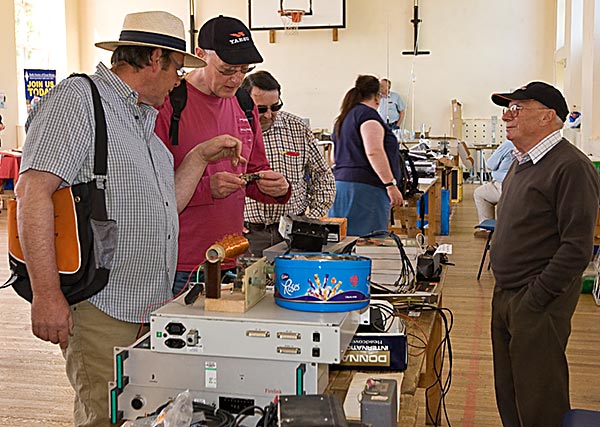
The Spalding & District Amateur Radio Society's Annual Rally was held on Sunday 5th June and, once again, the weather Gods smiled upon us. The Rally is held at the Gleed School in Spalding which is a very spacious  venue, both inside and outside on the School playing field. Because of the abundance of space, this Rally is always a nice, relaxed affair with no overcrowding to tax the nerves.

There were many traders in the School Hall and the outside Boot Fair was extremely well populated. I am sure that everyone who attended found plenty to challenge their wallets. Judging by the constant stream of visitors carrying goodies back to the car park, traders did very well.

As usual I took a few photos of the event which can be found here;

 
Matt operating his Clansman Radio

One of the most important aspects of any Rally is the social interaction and we all managed to catch up with many friends that we normally only meet on the air.

Many thanks to all in the Club who worked so hard to ensure the Rally was a success and also a huge thank you to the traders and visitors, I hope that you all enjoyed the day.

Until next year, 73.

Saturday, 23 April 2016

Data, Contesting and using PztLog

One of the main reasons that I enjoy Contest operation is that they hone your operating skills and point out any equipment weaknesses in rapid fashion.  They also guarantee you quite a few contacts when other stations are only too anxious to work anyone - even me!

My station is a fairly simple one and probably quite typical of most Amateur Radio enthusiasts. My QTH is in the Fens, so flat with only local building obstructions until the hills rise quite a few miles away. It is also close to the centre of Town and very limited in space so will never be highly competative. That said, I must be in the same situation of the vast majority of Amateurs and it is here that the RSGB CC series of Club Contests gains appeal.

This year I have been directing my Contest activities towards the RSGB 80 meter CC series and in particular the CW events. My antenna for 80 and 40 meters is a trap dipole which is slightly shorter than a full sized antenna and just fits into the space that I have available by spanning the bungalow and both front and back gardens. It is only up at 10 meters agl and slopes down at both ends to about 6 feet agl but works quite nicely for inter G Contacts. This antenna has served me well, especially now that some of the RSGB HF Contests now include 40 meters.

There are 3 RSGB CC Contests each month from February through to July. One for each of; phone, CW and Data. To be competative you need to get as many Club members to enter as many events as possible. My Club has traditionally been more interested in VHF Contests and, up until recently, has not many very active members who enter CW Contests. As my main area of interest is CW, this gives me in a distinct disadvantage - a single station using a single mode is never going to do well.

I am not really one to  make New Years resolutions but I did promise myself that I would enter a Data Contest this year, mainly to give my modest CW scores a little boost. I have operated RTTY before but that was about 20 years ago using an old BARTG Multyterm and a very primitive, noisy, computer. These days my main HF Radio is a Kenwood TS590 which is very easy to interface with my laptop and the software available now should make life much easier.

For HF Contests there is a requirement to generate a Cabrillo file for the entry so my main choice of logging software is usually N1MM and, while I only use it in a very simple fashon, it is relatively easy to set up for CW. On data modes however things start to get more involved and I have struggled to get it all to work properly. Recently I have been using PztLog by Charlie, M0PZT,for my general logging and that also includes a data mode operating facility, at least for RTTY and PSK which are the 2 modes needed in the RSGB Contest. It is very easy to set up and also includes a simple "Contest mode" to generate and log serial numbers. It can also generate a Cabrillo file from a selected number of QSO's. For my first data contest I thought that I would give it a try.

Using software for Contest operating involves setting up macros to efficiently automate the Contest Exchange and I was pleased to find that in PztLog it was easy to create a set of simple macros that did the job. Being more acustommed to N1MM I used the <exchange> macro in the template instead of using <serial> and found that I needed to type in my own serial number as well as the one received. For search and pounce operating this was not too much of a problem but a bit inconvenient. When it came to generating a Cabrillo file for my entry I found that the number of Cabrillo templates was very limited and I needed to drastically edit the file in Notepad before it was accepted by the RSGB.

I emailed Charlie with my comments and he replied very quickly, informing me to to use the <serial> macro to automate adding my serial number in the exchange and he is also going to produce a template for the RSGB 80M CC contest. PztLog is probably not the first choice of software for dedicated Contesters but its simplicity certainly has a lot of appeal for general Club use and the "waterfall" display was extremely clear to select stations to work. Support from Charlie is also very good so I will be using it again.

Operating in the Contest raised a few questions, the main ones being what power to use and how to set up the radio. PSK is a very efficient mode and power levels above 25 watts are not normally necessary. It is also recommended to turn off the ALC but I did not read that until after the contest! I set my power level to 50 watts and left the rest of the radio settings to the same as I use for CW. I am not sure how "clean" my signal was but I did not receive any complaints and received replies from most of the stations that I called. I treated RTTY and PSK in much the same way and am not sure if that is correct so more research is needed before my next data contest in May. Any advice on these last comments will be gratefully received.

I have not been active using data modes before but it is very tempting as there always seems to be some data activity on the bands when other modes are seemingly dead. I managed to complete 43 contacts and was pleased with that for a first attempt. I must however read up a bit more to make sure that my signal is as clean as it should be.

I have, since the Contest, got N1MM plus FlDigi to work but is still in need of a lot of tweaking before before it replaces PztLog. The simplicity of PztLog has got me into using a mode that I would not have used before. The free version of Ham Radio Deluxe can also be used and incorporates many more modes than I have even heard of but it does not generate Cabrillo files for the entry.

My thanks to Charlie, M0PZT, for his prompt support.

73 es cul, Jim GØHGH

 Update 21/05/2016

Since I wrote this report, Charlie has updated the Cabrillo export with a template for the RSGB 80 meter CC. It's great to have a software writer who reacts to his customers requirements. Thanks again Charlie.

I have also tried the Skimmer feature in PZTLog which worked well but after ten minutes of Contest operating my brain could not cope with the amount of information that was invading my senses. I went back to simple search and pounce operation for now but it is certainly a feature that I need to investigate further.

73 es gud contesting, Jim GØHGH

............................................................................................................


Saturday, 2 April 2016

Where's my UBN?

CW is certainly my favourite mode but when it comes to contesting it can be rather nerve wracking. I am more of a slow but sure kind of operator and just find writing fast enough for the speeds involved in serious contesting a bit mind boggling. That's even before we mention my typing skills which are two fingered at best (one on each hand, just in case anyone gets the wrong idea). 

For logging HF contests I have settled on N1MM+ for both the logging and 90% of the sending. If the station on the other end of the QSO asks a question I have to intervene manually with a key, even my laboured pace is faster than typing. Transcribing a paper log after a contest always seems to induce errors so live logging is a must for me.

The RSGB 80 meter CC Contests are my favourite Contest by quite a long way. They are friendly and quite relaxed affairs. The maximum power level allowed is 100 watts, so it is possible to compete on a fairly level playing field. Some stations rattle away at a fair old pace but my 20 wpm limit is tolerated amicably by the big boys.

The first CC Contest of 2016 was 18th February and conditions were extremely poor. I only managed 10 QSO's in the hour and a half. Even strong sounding stations had so much distortion on their signals that all stations were quite difficult to copy accurately. I was tempted to only enter a check log as I had scored so pitifully but it seemed that I was not alone so duely placed my entry to find that quite a few other stations had not reached double figures.

The second Contest was in 16th March and conditions were much better and I worked 52 other stations just by S&P through the band. Not a great score but a most enjoyable hour and a half.

UBN's are adjudication reports that inform you of any errors in your submitted log and it is normal to receive  a couple of error reports in any given Contest. So far this year in both of the above Contests I have received no UBN's, a fact that gives me great satisfaction and recompenses  for my lowly place in the results table. Being a member of FISTS I embrace their policy of "accuracy over speed" and no UBN means my accuracy is improving.

I probably should not tempt providence as the year is yet young with many more opportunities to tarnish my unblemished record. But - So Far So Good.

73 de Jim G0HGH 

Update 15/04/2016
The results from the 3rd leg of the Contest have been released and my clean slate has been tarnished. Just one UBN with a serial number being out by one. I am not too upset by that, especially as my score was much higher than the previous two Contests.

73 de Jim G0HGH 

Wednesday, 30 March 2016

New QSL Card Design

Last year most of my Amateur Radio activity was in the RSGB UKAC VHF contests. This year things have changed a bit. I wanted to get back into CW on HF so built a Cobweb, 5 band antenna to compliment the 80/40 trap dipole.

As the QSL cards come trickling in I thought that I had better respond to a few of them!
 
After reading Charlie's Blog, I thought it time that I had a decent QSL card. The last time I designed a card and had it properly printed, I ended up moving house a couple of months later. Consequently, I have never gone out of my way to repeat the exercise. However, as I cannot see any way that I can down-size any more than I already have, the time has arrived to put some thought into a nice design.
 
I took a photograph of the River Welland as it meanders through Spalding, making sure it was on a sunny day. I must confess that I am fairly proficient at using Photoshop so removed a bent cycle path sign and a few bits of  rubbish and adjusted the colours so that it was a vibrant, welcoming scene.
 
Text was then added and enhanced with drop shadow and  emboss effects.
 
Next stop the back of the card.
I had a fairly recent shot of me in the Radio Shack so reduced it to black and white and also reduced the intensity so it was pale grey. Added some boxes and labled them. Added a text box with Equipment details and finally added my call and a place for the recipients call to be written in.
 
Next stop finding a printer. Back to Charlie's web site I think for a few suggestions from him. 
Then it's back to the Radio so that I will have a use for some of these cards once they are printed.
 
73 es gud DX, Jim
 

Sunday, 15 November 2015

Loaded Dipole Tuning

I am not a regular operator on Top Band so, at this time of year when the RSGB Club Calls Contest arrives, it sees me dragging the tangled mess of wire that is my 160 meter dipole out of hibernation in the shed and getting it back into active service.

Like many urban dwellers, I do not have the requisite amount of space to hoist up a full size dipole for top band so have constructed a shortened version with loading coils in the centre of each leg. This affords me a resonant dipole but with a much restricted usable bandwidth, but, at least it gets me on the band and able to score some points for my Radio Club (S&DARS).

My prefered mode of operation is CW and most of my antennas are resonant dipoles that are tuned to the low end of any band. As the Club Calls Contest is a Phone one it requires shortening the antenna to tune it for the Phone segment of the band. This is usually simply a matter of folding back the ends of the dipole and fastening with a few cable ties. But by how much?

My usual approach to shortening a dipole for the phone section of the band is to use the trusted magic formula; 468/Freq to calculate the theoretical length of the antenna at two different frequencies; that at the low end of the band for CW and that of the new required frequency in the Phone section and noting the difference between the two lengths. This normally gives a fairly good guide on how much to fold back before fine tuning with an analyser but, with my loaded dipole, this proved to be wildly inaccurate.

Using the magic formula, the difference in length of each leg between an antenna resonant at 1.818 and 1.920 MHz is 6.8 feet, or approximately 82 inches. In practice, for my shortened dipole with quite hefty loading coils at the centres, the actual difference turns out to be just 22 inches.

I realise that the effects of a loading coil are more complex than simply one of wrapping some of the wire into a coil. For me though it makes the use of an antenna analyser so much more valuable. At the time of purchase I did baulk at the cost but have subsequently found its value to be inestimable.

73 and hope to work you on the bands, whatever the mode.

Monday, 8 June 2015

2014 2 Meters FISTS CW Award

Delighted to receive a certificate for 1st place in the 2104 FISTS CW Club 2 meters activity event. 

It was particilarly satisfying as the VHF activity was a FISTS tribute to Angie G0HGA and I did meet her many years ago when we both sat our CW test together. I was then G1UUM and living in High Wycombe, a particularly poor VHF location at the bottom of a deep valley. That was the original inspiration for learning CW in order to get the treasured "A" licence and to be able to work on HF.  While I was struggling to reach the necessary 12 wpm, she was, even back then, rattling it out like a seasoned pro. She did make quite an impression on me then and I was saddened to hear that she went SK.

Many thanks for all the QSO's that made this award possible.

73 


SDARS 2015 Rally


Monday, 11 August 2014

FSK and Meteor Scatter on 2 meters

My local Raadio Club, Spalding and District Amateur Radio Society (SDARS), recently had a video presentation, talk and demonstration on the use of FSK with WSJT  Software for making long distance contacts on 2 meters using Meteor Scatter.


This was a very timely talk as the Perseid Meteor Shower was due in a few days along with a DXpedition to IO41 by EI9E.

I must say that I had used this mode before, or I should say I had WSJT working before, but I had never made any contacts with it. I simply did not really understand what Meteor Scatter was all about. I certainly did not realise that this was a mode that can be used at any time as Meteors are constantly entering the Earth's atmosphere.

The video was by GW8JLY which told us what FSK and Meteor Scatter was all about. It was a very comprehensive video that didn't get bogged down in too many technicalities. Further explanation was given by Bob, G1ZJP, and then a practical demonstration was given by Julian, G4YHF, in the Club Raadio Shack which put the theory into practice. 

Still fired up with enthusiasm, I couldn't wait to give this a try at home and the next day was on 144.370 listening out for signals. I saw some decodes on the screen from OH6KTL and decided to give him a call. After a few QRZ's he got my call and after some time sending info to and fro, we completed the QSO.

So I had made my first Meteor Scatter QSO using FSK and WSJT software. OH6KTL is in KP02OJ, a distance of 1649 Kms and just using 30 watts to an 11 ele Tonna at my end.
I think that this is a mode that I could get into and will definitely be trying it again.

Thanks to SDARS for being such a pro-active Club. This is not something that I would have achieved before the presentation. Thanks guys.

73 De Jim GØHGH

.

Sunday, 3 August 2014

Deaf????

At some point every Amateur Radio operator must get filled with self doubt and wonder whether or not his signal is getting anywhere. Likewise, when listening to a fairly deserted band, is it imagination or is there actually a signal in that noise that I can just not make out. It must be sign of my insecurity in that, when I get some adverse criticism, I always think that it is me to blame.

In July, FISTS started a two meter activity event for an hour on Saturday evenings and another hour on Sunday mornings. In that first month I received more listener reports than I had QSOs. On the Yahoo group conversations it became evident that many operators were using low power and a  vertical antenna: the cross polarization losses are quite large so I was not too concerned.

In August, a suggestion was made that I was running huge power and  was extremely deaf! Perhaps someone should talk to me about it? Comments like this only fuel my anxiety so was starting to become a little concerned. I usually run 75 watts to an 11 element beam up about 10 to 15 meters agl depending upon wx conditions (and whether or not I got up early enough to pump up the mast).

Fortunately I have been competing in the RSGB UKAC Contests for a few years now and, if nothing else, they have given me a very good idea how well or poorly my signals have been radiating around Europe. For instance, when I first started contesting it was with a vertical antenna and 8 watts. Not surprisingly, my signal did not get very far, a maximum of 100Km, so it wasn't long before I upgraded to a 6 element 2 meter beam. That made a huge difference and I was working stations up to 250 Km away without too much trouble. Next came an upgrade to my current set up; an 11 element beam and 100 watts. With this station I find that I do fairly well and am confident in having a good idea on what I can expect from it. attaining 450 Kms is not unreasonable.

CW is a mode much more suited to making longer distance contacts so I was quite keen when the FISTS 2 meter activity sessions were announced. When I look at the log and analyse the QSOs they are however a bit disappointing. I have had two, quite hard work, contacts at 300 and 220 Kms where I gave 429 reports and received 579. Most other contacts have been quite local.

Interestingly, during one session I was called by a Contest station in IO75 and we exchanged very good signal reports (not unsurprising for contests!) but the QSO was pretty much as I expected - easy copy both ways and that was at 479 Kms.

So am I deaf or do FISTS members just not put out big signals? As I mentioned earlier many are using verticals, assuming a cross polarization loss of 25 Db and my antenna has a gain of 12 DB (assuming I have them perfectly aligned) that still leaves a loss of 13 Db. If the other station is running 5 watts from an FT817 or similar, that 13 Db loss is extremely significant. Not surprising then that if I am not perfectly aligned they are simply not audible here.

G0ILN has installed an HB9CV antenna at his stataion in JO00 square and he runs just 5 watts. I gave him a 429 report and I received 579 in return at a distance of 217 Kms. Another station in IO83 has a dipole sellotaped to his wardrobe door and can hear me, but I cannot hear his 5 watts. I really do not find that very surprising. Or am I too easily satisfied?

73 es good dx de Jim GØHGH 


Wednesday, 30 July 2014

70 MHz UKAC

I have never made any bones about it, I am just not really a /P operator. My last venture onto 4 meters was from a good, high location in Somerset and I did abysmally. Four meters is not a band that I had any equipment for so all of it was borrowed. Unfamiliarity tends to add the general state of confusion that I find myself in while portable operating. Fortunately there are not many 5th Tuesdays in the month to worry about so I have lived with the situation.

For this months 4 meter UKAC I was at home and determined to do a bit better. I ordered a 4 element beam from Andy, our "antenna man" at SDARS and also spent a bit more time setting the station up. The Transmitter was the same borrowed kit, An FT690 with transverter and small linear giving 20 watts. As usual I checked out the band plan to make sure where I knew where I was supposed to be going. 70 MHz is a bit different from other bands in that the bottom segment is for beacons and not CW. Phone and key share a calling frequency of 70.200 MHz.

The biggest improvement to my station was the addition of my shack headphones. I had taken them along last time but had the wrong 1/4" to 3.5mm adapter and could only hear from one earpiece!

Conditions were quite flat for the contest and that is fine by me as when others score very well, I tend to just score a little better than usual. A flat band tends to even out the "luck" of sporadic E contacts.

I passed my last efforts within the first hour so was well pleased. I went on to make 42 contacts in 12 multiplier squares.

I was happy to work several squares that often evade me, IO90, IO94 and IO95 but still cannot manage to find the number of squares more experienced contesters can conjure up.

Overall it was an enjoyable contest with a mixture of search and pounce along with some sessions calling CQ.

Many thanks to all for the points and hope to work you again in the next UKAC.

73 de Jim GØHGH


Tuesday, 17 June 2014

June 17th 23 Cms UKAC

23 Cms is a fairly new band for me and it is one that takes some getting used to. Not only do you operate the radio but you also have to arrange skeds using KST. It certainly adds another dimension to Contest operation.
Being fairly new to the band it should be quite easy to better your last score and so far things have been going in the right direction. This was certainly a personal best result for me. It wasn't down to the number of QSO's but to the number of multiplier squares worked - a total of 15 which I was very pleased with.

There was a lot of deep QSB on most distant signals with total fade out at some points so some perseverance was required on both ends of the contact.

I was pleased to say that CW played a small part n pulling in some of the weaker signals. Certainly G3YPQ/p in IO70SS would never have been worked on phone. I gave him a 529 and I received a 449 so it just goes to show how useful CW is in difficult conditions.

I run 10 Watts to a 55 ele Tonna up at 12 meters agl so low power but with high gain. A very sharp antenna so constant tweaking of beam heading made more difficult by QSB made it all quite hard work but most enjoyable.

There were a few SDARS stations on including G4YHF, G4ODA, G4NBR and G4KIY. Strangely I did not hear G4ODA all evening despite the fact that we are fairly close to each other.

73 es tnx fer all points.

Wednesday, 11 June 2014

80 meter UKCC Contest

CW contests are a bit of a strange affair really. I am normally found, plodding away at about 17 wpm on my paddle but as soon as you mention "Contest" we all become speed freaks. Unfortunately, I am just not very accurate sending or receiving above 20 wpm so some practice is prescribed.

The RSGB UKCC Contests on 80 meters are quite a relaxed affair really, and even has a designated frequency of 3.555 MHz for slower operators to have a go. Sadly a couple of DL's decided to have a very high power QSO on that frequency for a good part of the June Contest but as the band was not that crowded, it didn't detract very much from everyone's enjoyment. I usually concentrate my efforts towards the top of the band segment as things get more frantic the lower in frequency that you go. In fact the bottom 30 Hz tend to be rather manic.

In April I managed 38 contacts and in June's Contest manged to improve slightly making 43 contacts. Still a long way to go but I do not take it very competitively. For me it is about gaining experience and self improvement.

As mentioned, Contest operation is usually at much higher speeds than normal rag chewing and you really need to get your ears tuned in for a specific exchange. As all HF CW contest signal reports are 599 all you really need is the 3 digit number that follows the RST and the Call sign of course. This part of the exchange is typically sent at between 25 and 30 wpm, much too fast for most of us mortal operators, but it is amazing how fast you can read that limited exchange when you know what to listen for and practice for it.

Fortunately numbers are longer than any other Morse Code character so that helps. Unfortunately, many experienced ops tend to use abbreviated forms for the Zero and number 9. Whilst I don't mind the leading zeros being shortened to a "T" in the exchange (TT1), nor do I mind the 599 being sent as 5NN, but when they appear in any other place it disturbs my rhythm and makes me stop and think - a practice fatal in decoding CW. 

Search and Pounce (S&P) mode is the easiest mode to use as you have plenty of time to catch the call sign of the station that you want to work. Even if they are sending at 25 wpm you can normally get it correct if you listen to it a few times. Once you have his call sign in your logging programme all you have to do is send your own call sign once and then listen to hear if he is calling you back or someone else. Assuming the other station heard you correctly all you need to do is enter the default 599 for the RST and then listen for the next 3 numbers - your serial number. Even if you miss it and are too embarrassed to admit it you can listen for the number given to the next few contacts that station makes and work backwards to the number that you were given. Not too bad really. Then you just send 5NN and your 3 figure serial number to him. Simple really isn't it?

Whilst S&P is the easiest way to make contacts, you really need to call CQ to make the points. Then accurate copying of the other stations call sign is vital and it is not always easy when the band is crowded and you have QRM to contend with. You can practice call sign recognition though with contest emulator programmes like Morse Runner. Calling CQ and establishing a run frequency is much more stressful so start with S&P mode if you want.

Contest operating on the HF bands is not everybody's cup of tea but it is a great way to improve your own operating technique, gain confidence using CW and also to learn how to utilize some of the many controls on a modern rig, especially in the filtering department. 

To begin don't take things too seriously and just enjoy it. Get out of it whatever it is that you want and leave winning to the big boys. They are great for call sign recognition which is one of the most important skills that you can develop for using the HF bands outside of those dreaded contests.

If you feel like giving CW contests a go but are not confident enough, then contact me at the Club (SDARS members) and we can organize some practice sessions on the computer and/or on the key.

73 es gud dx de Jim G0HGH

Recovery Service!

What other Rally has a recovery service like this? Thanks for the Photo Andy.

It looks like Alan has discovered a new way of getting home after a visit to his local hostelry!

73 de Jim G0HGH

Tuesday, 10 June 2014

RSGB UKAC 70 Cms June 10th


Solar storms normally effect the HF bands rather than UHF, and there had been a couple of days  of poor conditions on the HF bands prior to this months Contest. Conditions seemed fairly poor on UHF though and trying to work IO81, 82 and 83 was really hard work. Whether this had anything to do with the Solar storm I do not know.

It wasn't until the last 30 seconds of the Contest that I managed to have a qso with Tony, GW8ASD in IO83 square for a new multiplyer. I am beginning to think that Tony leaves me until the last minute just to make me sweat. I only managed one contact in each of IO82, 82 83 and 95 squares; and they only happened in the last 20 minutes so it just goes to show,don't give up hope until the very end.

There were some huge signals but there appeared to be plenty of the room on the band. I managed to hold a run frequency on 432.127 until the last half hour. After I lost control of that I went search and pounce until I found a free spot around 432.175 for the last few minutes.

Thanks to everyone for the points, some contacts were a bit hard work and some of the regulars were not heard at all.

I ran 9 watts to a 19 element beam made by SDARS member Andy 2E0WAX up at 12 meters agl. I also used a HA8ET LNA at the mast head with Ecoflex 15 feeder.

Once again my admiration goes to those stations who seem to able to find those extra, magic multiplyers. 

73 es gud dx de Jim G0HGH

Wednesday, 4 June 2014

RSGB UKAC 2 meter Contest

June 3rd RSGB UKAC 2 meter Contest map

Conditions seemed pretty good for this months 2 meter Contest but, as usual, some stations reported working into Italy earlier in the day with all sporadic E dying out by the time it was due to start the Contest.

I believe that I am starting to make some headway in Contests after the many station improvements that have been made over the last two years, but make no mistake, doing well in Contests is as much about operating skill as it is having the equipment. Even with the best equipped station I am sure that I would still struggle to improve my scores and still have much to learn.

I worked 16 multiplyer squares and must admit that I wonder how or if I will ever get to work any more than that. It must be possible as fellow SDARS Club members; M1MHZ managed a staggering 24 squares and G4YHF managed to work 18 with just 10 watts. SDARS member G4ODA was working as GM4ODA/P in IO99 but the WX in N. Scotland was atrocious and the distance too great for me to even hear him which was a pity.

Best DX for me was OZ1ALS who was not beaming my way at the time, but I did manage to catch his attention at 705 Kms. I occasionally hear, but very rarely manage to work, him during a Contest so very pleased with that QSO.

2 Meters is probably the most popular of the Amateur bands and certainly is the band for which a huge number of Contesters are very well equipped so it is extremely competitive. As a result, if I do well you can guarantee that everybody else did even better when it comes to scoring the points.

A total of 62 QSO's in 16  scoring Squares with an extra 2 Continental squares and a few points added to Spalding and District Amateur Radio Society's tally.

73 de Jim G0HGH IO92WS

                   *******************************************************************